It’s hard to talk about someone you know who passed away, but, believe me; it’s harder when you talk about someone you know nothing about. To know someone better, you have to read his writings or, simply, read what his friends wrote about him. Reading what a disciple of his, David M. Morens the director of the National Institute of Allergy and Infectious Diseases, wrote about him made me believe that Dr. Gregg is the luckiest person on the planet by gaining this undeniable love & appreciation from his students. Dr. Gregg died on July 9, 2008 at the age 78.
Michael B. Gregg, M.D. was born in 1930 in Paris, France. He was educated at Stanford University and Western Reserve University School of Medicine. He entered the Public Health Service in 1959 right after he completed his residency in internal medicine at Columbia Presbyterian Hospital in NY. He first served at the National Institutes of Health Rocky Mountain Laboratory. He then trained in infectious diseases in Lahore, Pakistan before he joined CDC (it was known as the Communicable Disease Center) in 1966 as Chief Epidemic Intelligence Service Officer (EISO). From 1967-1988, Dr. Gregg (or Mike like everyone in the CDC used to call him) was the editor of the MMWR. His writing style “just the facts” made thousands of epidemiologists believe that good medical writing indicates clear thinking, which is the only thing needed in Epidemiology. In 1975, Mike was the MMWR editor, Viral Diseases Division director and deputy director of the Bureau of Epidemiology.
Mike was not only a MMWR editor, but he taught hundreds of students in NIH & CDC to become leaders in epidemiology & public health. Mike’s textbook “Field Epidemiology” (Don’t get extremely excited, It’s a link to the review not the book itself. My apologies.) is the “go to” book in breakout investigation & to solve public health issues. As David M. Morens says, it reflects his very wide experience in national as well as international epidemiology including:
- Pontiac fever/Legionnaires’ disease (1968/1976) [Ligeonella pneumophila – Philadelphia] First, it was thought to be a 1918-like influenza pandemic, but Mike kept running through the history of Influenza & other respiratory diseases, the epidemic ones. After a couple of days of collecting info, Mike was the first to say: “This is beginning to look like Pontiac fever.”
- Swine flu (1975–1976) [Hsw1N1 – New Jersey]
- Guillain-Barré syndrome (1977)
- Ebola hemorrhagic fever (1976) [(-)ssRNA virus – Zaire & Sudan]
- In the June 5, 1981 issue, he published a report about 5 Pneumocystis carinii pneumonia cases. Such disease was rare, so he wrote a note saying: “the case histories suggested a cellular-immune dysfunction related to a common exposure, a disease acquired through sexual contact”, which we know now as HIV/ AIDS. It was the first report about it.
- He helped in putting on the epidemiology map of Reye syndrome (1973–1977) [A fatal disease associated with Aspirin consumption when having a viral-disease e.g. Varicella – Ohio] , Kawasaki disease (1977), and toxic-shock syndrome (1980) [S. aureus]. He was consulted in the SARS outbreak in 2003 [Severe acute respiratory syndrome (+)ssRNA coronavirus] even after his full retirement.
Mike used to give the epidemiology course each July. The first subject was: “How to investigate an epidemic”. His first words were: “First, you need to find a good map…” He was teaching his students to keep an open and interested mind, to remain flexible and creative, to rethink and to assemble the puzzle pieces quickly to get the big picture.
“It’s better to be approximately right today than exactly right tomorrow,” a phrase said by Michael O’Leary, a former epidemiology student of Mike rephrasing his description of epidemiologists’ work: “Quick and dirty”.
Image credits:
Michael B. Gregg: http://www.cdc.gov/
Tags: ebola hemorrhagic fever, field epidemiology, Guillain-Barré syndrome, Michael B. Gregg, MMWR, Pneumocystis carinii, pontiac fever, reye syndrome, SARS outbreak, swine flu, toxic-shock syndrome
 2 Comments »
Normally when we hear the word immunity, we think of defense against infections, graft rejection, inflammation, etc. But, what if this defense may cause more damage than the infection itself ? In this case, the immune system shows a certain privilege through acting smarter where it deviates its mechanisms in a way to down-regulate its own damaging mechanisms. This whole process is known as Anterior Chamber-Associated Immune Deviation (ACAID).

image credit: http://research.opt.indiana.edu/
ACAID is endogenous to specific sites such as the anterior chamber of the eye and the brain. The process is considered as saving in cases of ocular infections where the visual axis is easily deflected by inflammation leading to blindness. Also ACAID is considered beneficial in case of allografting as it downregulates the immune processes responsible for allograft rejection. The process was discovered by Medwar in 1940, when he first noticed that surprisingly certain tumors proliferate more rapidly in the anterior chamber of the eye than anywhere else. Medwar’s further studies demonstrated the role of the process in transplantation immunology.
As an example of ACAID, upon antigenic inoculation of anterior chamber of the eye, the immune deviation presents itself as follows: Instead of Natural Killer T-cells perform certain functions attributed to T-Helper & T-Cytotoxic cells, the antigen injected into the eye APCs (Antigen Presenting Cells) that carry antigen to the spleen. These APCs activate NKT cells which in turn produce certain cytokines as TGF-ß that induce the generation of CD8+Tr cells which by production of cytokines such as TGF-ß and IL-10, can downregulate subsequent Th1-mediated DTH reactions against the same antigen.

image credit : http://www.nature.com
Thus, regarding the beneficial effects that can be drawn from ACAID, current research is being conducted for inducing ACAID to avoid graft and transplant rejection. ACAID can be induced by animal injection with non-ocular APCs, e.g., peritoneal exudate cells (PECs) that have been precultured with TGF-ß and antigen in vitro. Such procedure is believed to be a step forward toward the success of transplantation.
Tags: Anterior Chamber Associated Immune Deviation, APC, cytokines, graft, immunity, Medwar, ocular, T cells, Visual axis
No Comments »
The title stunned me as I was surfing the Yahoo News. At some evolutionary phase, birds really did have thumbs. So what happened to them? Researches at Yale University and the University of Wisconsin propose that it shifted its position after studies made on the gene expression in crocodiles, as published in PLoS ONE.
Going back now, birds have only three fingers, which until very recently where believed to be the 2nd, 3rd, and 4th respectively. The only problem this faced was that fingers in the early birds such as Archaeopteryx correspond to number 1, 2, and 3 “thumb, forefinger, and middle finger”. Fossil records clearly indicate that finger 4 and 5 “ring and pinky finger” were lost in the flying dinosaur ancestors of birds.
To end this debate, researchers began to focus on the expression of HoxD11 gene. In mice, digit 1 had no expression for this gene, which also held true for the 1st digit in birds, which suggests that in reality, it is actually a thumb. But to test this, it was compared to crocodiles, the closest living relatives to birds. The findings did in fact support what they suspected. The expression, as in mice, was absent only in finger one “the thumb”
So, birds at one time had thumbs. And the fact remains because they still do. It chose to develop at a different position in the body, that’s all.
Tags: birds, crocodile, digit, dinosaur, finger, HoxD11, thumb
2 Comments »
Nothing is impossible..
Things, you think are absolutely harmful, may be highly beneficial if we use them in a new way.
Viruses can be used in the treatment of cancer, a field known as oncolytic virotherapy.
But can you imagine that they are safer & highly specific than other traditional chemotherapy???
You will get the key when you know that they destroy cancer cells with a high accuracy that scientists called them “magic bullet”.
Simply, the mechanism of most viruses is to infect our cells, then to use them as a factory to produce more & more viruses.
Viruses are highly specific, they replicate in cells having receptors for them. So, we need to change viruses to selectively bind to tumors.
In fact, a virus consists of a coat & genome.
So, we got two methods to generate tumor selectivity.
First: By making modification on viral coat in order to increase adhesion between coat & cancer cells “Transductional Targeting”.
Second: By altering viral genome, so it can only replicate in cancer cells “Non-Transductional targeting”.
However, many primary cancers were resistant to conventional virotherapy.
Researchers at McGill University and the affiliated Lady Davis Research Institute of the Jewish General Hospital, along with colleagues at the University of Ottawa and the Ottawa Health Research Institute (OHRI) have discovered that a family of compounds called histone deacetylase inhibitors “HDI” which convert oncolytic viruses into more potent weapon.
So, HDI can augment the ability of the virus to target & kill the cancer cells._EM_18_lores.jpg)
Many viruses can be used especially those with dsDNA
genomes “as adenovirus and herpes simplex virus” where they have a higher stability & less susceptible for mutations.
Researchers utilize Vesicular Stomatitis Virus “VSV” as it is not a human pathogen. So, most individuals don’t have antibodies against it & can be treated before they gain immunity.
Human trials have been already approved & the results of these experiments will determine if this viral bullet is really a “magic bullet”.
Source: ScienceDaily
Image credits: Vesicular Stomatitis Virus
Tags: cancer cells, histone deacetylase inhibitors, magic bullet, non-transductional targeting, traditional chemotherapy, transductional targeting, tumor selectivity, vesicular stomatitis virus
5 Comments »
Who could possibly believe that our anaerobic spore-forming Clostridia will be used as an anti-tumor therapy?! It’s called Clostridium-based tumor targeted therapy. “Give me a break,” that’s exactly what I said when I read the review of the new book Clostridia: Molecular Biology in the Post-genomic Era.
So, how does it work? There are various non-pathogenic Clostridia strains which could replicate within solid tumors upon systemic administration. The interesting part is coming right up: Why solid tumors?! It’s because of its very unique physiology; it characterized by hypoxia & necrosis which totally fits the anaerobic Clostridia. The advantage will be the selectivity & targeting of the cancer cells leading to destroying them.
It was news to me to know that Cl. perfringens causes food poisoning like any food-borne illness & causes antibiotic-associated diarrhea (When I hear the name Cl. perfringens, I orient myself toward gas gangrene right away). Its enterotoxin gene (cpe) is present on the chromosome itself (in food poisoning isolates) and on the plasmid (in the antibiotic-associated diarrhea isolates). The enterotoxin binds to claudin receptors, then there’s oligomerization or “prepore” formation & finally prepore insertion takes place to form the functional pore which kills the cells by apoptosis. So CPE/CPE derivatives could be used for cancer therapy.
Tags: anti-tumor, clostridia, Clostridium-based tumor targeted therapy, CPE/CPE, enterotoxin, solid tumors
2 Comments »
Did you ever think about only one disease that causes the death of 50 million people? and around a year!!!!
Unfortunately, it already happened between 1918-1919 and is known as Spanish flu.
Flu (influenza) is a highly contagious respiratory infection caused by influenza viruses, which are divided into three types A, B and C.
Type A influenza is the most frightening and epidemic.
Type B influenza causes milder symptoms than type A.
Type C influenza tends to be mild and does not spark epidemics.
Type A flu virus is subdivided into subtypes based on two surface proteins, hemagglutinin (HA) and neuraminidase (NA).
Now, Scientists know 16 HA subtypes and 9 NA subtypes of the flu virus.
A (H1N1) and A (H3N2) are the subtypes of influenza A viruses found in people, and there are no subtypes of influenza B virus.

The influenza viruses contain eight segments of single-strand RNA , continually change over time through “antigenic drift” or “antigenic shift”.
So, there is new flu vaccine every year and from time to time we face a new flu outbreaks.
Now, there is real fear between scientists and people of transmission of influenza viruses from animals to people.
There is a promising trial of new flu vaccine , targeting the internal proteins of the virus, this vaccine may be used in vaccination of many viruses like flu in mechanism of infection. (you can see BBC report Here).
References :
Flu
What Is Flu?
Types of flu
Influenza virus
History of Flu Epidemics
The Influenza (Flu) Viruses
Types of Influenza Viruses
Flu Virus Can Change: “Drift” and “Shift”
For Further reading
Seasonal Flu
Flu Channel
Cold Channel
Bacterial Pneumonia and 1918 flu
Tags: 1918 flu, antigenic drift, antigenic shift, flu, flu outbreaks, hemagglutinin, influenza, neuraminidase, spanish flu, ssRNA, types of flu, vaccine
No Comments »
 Researchers at Yale & the University of Chicago were faced with a surprising conclusion based on their scientific experimentation on mice. Unlike the common belief that microbes are in fact “bad” & possess a harmful threat to our health, some of these bacteria prove their innocence. Mice, that were exposed to common bacteria in the normal gut flora, were protected against the development of Type I diabetes. Previous research had shown that mice, exposed to killed Mycobacterium tuberculosis, were also protected. So, this means that mice that grow in their natural habitat are better off than the ones raised in the much improved sanitary conditions of the lab. Researchers at Yale & the University of Chicago were faced with a surprising conclusion based on their scientific experimentation on mice. Unlike the common belief that microbes are in fact “bad” & possess a harmful threat to our health, some of these bacteria prove their innocence. Mice, that were exposed to common bacteria in the normal gut flora, were protected against the development of Type I diabetes. Previous research had shown that mice, exposed to killed Mycobacterium tuberculosis, were also protected. So, this means that mice that grow in their natural habitat are better off than the ones raised in the much improved sanitary conditions of the lab.
This comes to support the hypothesis many scientists have lately adopted. They tend to believe in a directly proportional realtionship between a person’s exposure to parasites, bacteria, worms, etc.. within the surrounding evironment and his immunity. The more, the better..that is within limits of course.
This actually makes perfect sense to me. It is really obvious when you see, for example, people living in third world countries with mosquitoes hovering around and considered normal. But when they travel abroad for a while and come back, they get different sorts of allergies & rashes from those previously “harmless” mosquitoes. What parasites and microbes do for you is not all bad. Unfortunately, I had to experience this dilemma.
Source: ScienceDaily
Tags: bacteria, diabetes, flora, immunity, mice, tuberculosis, Yale
No Comments »
Sept 16th:
Hi, Diary;
Now it’s in the press. It’s humiliating. In Scientific American, it was written under the title: Turning Bacteria into Plastic Factories. So that’s what we, E. coli, turned into: slaves for humans to do whatever they want us to do.
I remember this like it happened yesterday. It was someday in the beginning of the year 2008. That day we found ourselves in those tanks, large ones, filled with sugar & water. “This is great; we can ferment the whole amount of sugar in the tank. This is the perfect place to live in,” that is what we thought. Then we got this strange order from our genomes or plasmids, I’m not sure & found ourselves producing that enormous amount of 1, 4- Butanediol (BDO). This was so strange because BDO used to be toxic to us at low levels (I’ve heard once that any production of a non-native material inhibits our growth). Then we realized the truth; we’ve been genetically engineered to tolerate BDO, the raw material for a very large number of plastic, rubber and fiber products including solvents, fine chemicals, pharmaceuticals, automotive components, electrical and electronics components, as well as apparel fibers.
Honestly, I don’t know. Sometimes I feel that bioengineers from San Diego-based Genomatica, Inc. are right after all; they modified us, they wanted to make use of us, they wanted to save money & energy needed to produce BDO from non-renewable petrochemical feedstocks, the currently used method. Plus it causes us no harm as Bioengineer Christophe Schilling, president and co-founder of the company said: “We have engineered the organism such that it has to secrete that product in order for it to grow.”
Now I know what it feels like with my fellow bacterial species, the natural born producers. Most bacteria synthesize the organic polyesters Polyhydroxyalkanoates (PHAs) to be used as a carbon & energy storage material. Now they’re discussing the ability to use these PHAs as biodegradable plastics.
 Source: A piece of a plastic notebook found in the Petri dish appears in the picture below, Genomatica labs, San Diego. Source: A piece of a plastic notebook found in the Petri dish appears in the picture below, Genomatica labs, San Diego.
Image credits:
Genetically engineered E. coli may produce plastics: http://www.sciam.com/
Tags: BDO, biodegradable plastics, Christophe Schilling, genetically engineered, Genomatica, PHAs
3 Comments »
 Have you ever heard about the terrorist attacks of anthrax via mail in 2001 in US that finally ended with Bruce Ivins, the chief suspect in those attacks, committing suicide? Have you ever heard about the terrorist attacks of anthrax via mail in 2001 in US that finally ended with Bruce Ivins, the chief suspect in those attacks, committing suicide?
What about tracing microbe sources as in the Salmonella US outbreak?
This is microbial forensics.
Microbial forensics uses biological analysis such as genome sequencing, protein and carbohydrate fingerprinting to figure out the source of a biological agent. 2001 was not the year which witnessed the emergence of microbial forensics. Actually, in 1998 a doctor from Louisiana, who intentionally infected his former mistress with HIV, had a trial in court. But the anthrax attacks were really the reason for the amplification of the role of microbial forensics as it was followed by government funding and developing the sequencing techniques into more cheaper ones.
As a result, microbial forensics is extrapolated to further applications beyond biocrimes. In molecular epidemiology, it will help figuring out the source of food or water borne diseases such as in recent US Salmonella outbreak. The field also is expected to provide help in hospital-acquired infections. Many people sue hospitals every year claiming they got MRSA (methicillin-resistent Staphylococcus aureus) infection from a certain hospital. Tracing the source of the infection will prove whether those people really contracted the infection from the hospital or from any other outside source.
Image source
Reference: Ontogeny
Tags: bioterrorism, Epidemiology, forensics, MRSA, nosocomial infections, Salmonella
5 Comments »
 Recently, I have been able to get in touch with Professor Jan Roelof van der Meer after reading about his work in EurekAlert in the field of color-coded bacteria. Currently, he is an associate professor at the Department of Fundamental Microbiology, University of Lausanne. Recently, I have been able to get in touch with Professor Jan Roelof van der Meer after reading about his work in EurekAlert in the field of color-coded bacteria. Currently, he is an associate professor at the Department of Fundamental Microbiology, University of Lausanne.
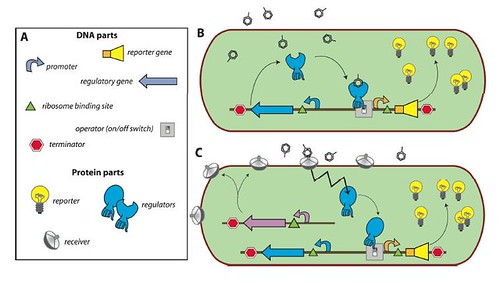
In a review published in collaboration with Professor Robin Tecon, the researchers explained why the bacteria were specifically useful in the detection & tracing back the age of oil spills, chemicals and other pollutants leaking into seawater and the soil. Since the bacteria are easily manipulated, researchers were able to genetically produce MBS “Microbe-Based Sensors” which produce specific reporter proteins when in contact with a certain pollutant. Such reporter proteins can then be detected merely by observation or instrumentally.
Enclosed within the review, this figure illustrates the concept of a bacterial sensor-reporter cell where the benzene-ring-look-a-likes represent the pollutants.
And I leave you with the interview:
1. Is there hope that MBS won’t just play a role in detection, but in cleaning up as well?
Normally not. To enhance biodegradation rates in the environment, one usually tries to stimulate the bacteria which are already present at the site. There are no cases where genetically modified bacteria were applied to clean up contamination.
2. How can this method trace back the age of a spill?
Interestingly, we found that there seems to be a specific pattern of dissolution of different compounds from oil. A fresh spill will first ‘show’ linear alkanes and compounds like benzene, toluene, ethylbenzene. Only later will polycyclic aromatic hydrocarbons, like naphthalene, appear. We had not seen this before, because one typically cannot measure the first phase of an oil spill, since this is detected only after a while.
3. Which method do you prefer in the genetic engineering of these MBS?
Depends. For E. coli, we use very classical cloning techniques involving plasmids. For other bacteria, we have to use transposon delivery methods mostly.
4. Is the acquired trait of producing a reporter protein passed on to future generations of the bacteria?
Normally yes. If the reporter construct is integrated in the genome of the bacteria, it is relatively stably maintained even without selection pressure for the marker. When the construct is on a plasmid, like in E. coli, one has to constantly keep the ‘pressure’ for the marker on the plasmid, usually an antibiotic resistance marker.
5. This field, as you kindly mentioned, started 20 years ago; what hope lies for its progess in the future?
My major hope is that people (industries, labs) finally apply the methods in their analysis as alternatives for costly chemical analysis. Further progress has to come from miniaturization, multiple target detections and improved methods to preserve the bacterial cells.
Tags: bacteria, biosensor, color coding, genetic engineering, Lausanne, MBS, oil spill, reporter protein, van der Meer
2 Comments »
|


_EM_18_lores.jpg)


 Entries (RSS)