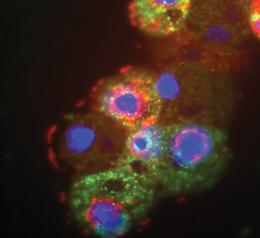
 Once upon a time, in 2003, a French team discovered a giant virus infects amoeba. It was isolated from a cooling tower in the UK. They were so excited because it was so huge with a genome contains 900 protein-encoding genes (The words giant/ huge are totally hilarious. It’s not “Hulk”, it’s just a virus). It’s visible under the optical microscope. They named it Acanthamoeba polyphaga mimivirus (APMV). The prefix “mimi” is for mimicking microbe. Now, the same team “Raoult’s team” reported the isolation of another strain of those giant viruses but this time it was isolated from a cooling tower in Paris. They named it “mamavirus” because it was slightly larger than the previous giant virus (APMV), but it wasn’t alone. It was associated with its satellite, a small virus has 21 protein-encoding genes infects it, hijacks its viral factory making copies of itself, hindering the ability of the mamavirus to replicate/ make its own copies, so the number of the mamavirus drops in the infected amoebae. They named it Sputnik after the first man-made satellite. It’ll be the first isolated “Virophage”. How did I know about it? From the amazing blog of Dr. Ramy K. Aziz, “Microbes“. Once upon a time, in 2003, a French team discovered a giant virus infects amoeba. It was isolated from a cooling tower in the UK. They were so excited because it was so huge with a genome contains 900 protein-encoding genes (The words giant/ huge are totally hilarious. It’s not “Hulk”, it’s just a virus). It’s visible under the optical microscope. They named it Acanthamoeba polyphaga mimivirus (APMV). The prefix “mimi” is for mimicking microbe. Now, the same team “Raoult’s team” reported the isolation of another strain of those giant viruses but this time it was isolated from a cooling tower in Paris. They named it “mamavirus” because it was slightly larger than the previous giant virus (APMV), but it wasn’t alone. It was associated with its satellite, a small virus has 21 protein-encoding genes infects it, hijacks its viral factory making copies of itself, hindering the ability of the mamavirus to replicate/ make its own copies, so the number of the mamavirus drops in the infected amoebae. They named it Sputnik after the first man-made satellite. It’ll be the first isolated “Virophage”. How did I know about it? From the amazing blog of Dr. Ramy K. Aziz, “Microbes“.
The story won’t stop at this discovery. The discovery of the virophage will strongly suggest that “Viruses are alive” because they share something with other living domains of life, they can be infected, they can get sick, what makes all health-care providers totally thrilled because there’s something stronger than viruses which could be used to fight them, but “It’s too early to say we could use Sputnik as a weapon against big viruses or to modify them,” says co-author Bernard La Scola.
One more thing about Sputnik, 3 of its genes are closely related to APMV which suggests horizontal gene transfer between giant viruses caused by Sputnik. This is so “bacteriophagic”, reminds me with the whole insertion/ lysogenic mechanism between phages & bacteria. The isolated sequences from the ocean are closely related to the genome sequences of giant viruses & their satellite (Sputnik) . They infect plankton. “It suggests there are other representatives of this viral family out there in the environment,” Koonin says.
Image credits:
Giant mamavirus particles (red) and satellite viruses of mamavirus called Sputnik (green). http://www.nature.com/
Tags: APMV, horizontal gene transfer, mamavirus, sputnik, virophage
 No Comments »
 Many drugs can’t do it, but GBS can! Many drugs can’t do it, but GBS can!
Bacterial meningitis is one of the leading causes of death and disability among childrens. Meningits occurs when bacteria cross blood brain barrier (BBB) after interacting with human Brain microvascular endothelial cells (hBMECs) . Although these cells are exhibiting tight junctions and lacking pinocytosis, some bacteria could cross it and this demonstrates an interplay between host cells and some bacterial factors.
Scientists at USCD school of medicine used a process involving generating and screening of many group B streptococcus (GBS) in tissue culture model of human BBB (consisting of immortalised hBMECs) . This culture maintained the normal function of human BBB.
They identified a gene called iagA gene encoding for a glycosyltransferase. A predicted product of the iagA glycosyltransferase is the glycolipid diglycosyldiacylglycerol involved in anchoring lipoteichoic acid (LTA) and consequently, enhances BBB invasion.
Allelic replacement of the iagA gene,so that the resulting mutants are lacking the gene, shed LTA into the media. As a result, mice infected with mutant gene exhibited less mortality rate -up to 90 percent- compared to wild-type infected mice. Mutant-type infected mice developed bacteremia as WT which proves the fact that iagA gene plays the central role in BBB invasion without significantly affecting adhesion or blood survival.
Since bacterial meningitis may cause infected children death or many complications as permanent cognitive deficits, blindness, deafness or seizures, an early treatment may help reduce high rates of death and disability.
This early treatment may be much more easily designed after these findings by blocking LTA anchoring on bacterial cell surface.This will help preventing meningitis even though bacteriemia has taken place.
The journal of clinical investigation has the full story.
Tags: drug targets, GBS, meningitis
No Comments »
As seen on Oprah :), a new state-of-the-art blood test “Biophysical250” is available for a price tag ranging from $1500-3400 that actually determines the length of your telomeres, and thus give doctors an idea of how a certain individual is aging.
What are telomeres?
The chromosomes are often compared to shoelaces and telomeres to the plastic wrapping found at both ends. They are repeated sequences of nucleotides whose function is to maintain the integrity of our genetic code while the cell is dividing. This is mainly because during DNA replication, primers don’t attach to the very end of the strand. Instead, they often ‘miss’ a few nucleotides on both ends and if that were the case, then our genetic code would eventually vanish. This is why telomeres are very important.
Normally, as human beings, our telomeres start off with 8,000 base pairs which decrease each time the cell divides by 30-200 bp each time and may go as low as 1,500 bp in elderly people. Eventually when telomeres become too short, the cell stops dividing, becoming inactive ‘aging’.
An interesting hypothesis about telomeres is that stress is thought to play some kind of role in the determination of their length. In other words, the more stressed out you are, the shorter your telomeres become as you age. Needless to say, once stress has been coped with, it is thought that the rate at which telomeres shorten decreases dramatically which might be essential to longer healthier lives.
For more information, click HERE
Tags: aging, chromosome, telomere
1 Comment »
I have to admit that it is pretty odd “or at least for me” to learn the countless aspects of life itself that we, as human beings, share with primitive organsims “as in bacteria”…& yet add another to the growing pile: The Concept of Hand-in-Hand
Helmholtz Centre for Infection Research
Rarely do bacteria grow as single cells, they rather prefer to grow as colonies which adhere to all kinds of surfaces forming “biofilms“. These biofilms have proved to be pretty effective in maintaining the well-being of the bacteria growing within them and needless to say, this possess a serious threat. Nothing seems to work with them, ranging from disinfectants and antibiotics all the way to our very own immune system.
Scientists, now, have identified a mechanism which is thought to be used by the bacteria, within the biofilm, to protect themselves. Pushing star wars aside, these biofilm bacteria are using chemical weapons as their defense.
Taking a model for this study, researchers compared marine bacteria getting attacked by amoebae to these biofilm bacteria getting attacked by phagocytes.
To take a closer look, these bacteria are easily attacked when they are swimming separately in the water, but once they are attached to a surface, the amoebae can no longer harm them. Not only that, but the amoebae were sometimes de-activated or even killed. A classic example of FIGHTING BACK!!
How do they do it?? Through chemical weapons.
Marine bacteria contain the pigment violacein. If the enemy attacks just a single cell, the pigment is released paralyzing and triggering a suicide mechanism in the amoebae.
Amoebae are thought to be the ancestors of some types of pathogens. So, instead of thinking of biofilms as a problem, they may be source of highly effective agents which can only be produced in a biofilm and can help us fight aganist some of these pathogens.
After all, it IS a small world
Tags: biofilm, chemicals, colony
2 Comments »
To be frank, I was really underestimating these bacteria. Streptococcus iniae, bacteria bothering fish, what’s the big deal? But when I read that it cause them meningoencephalitis due to systemic dissemination resulting in death, it made me sad. They’re fish, you know, they don’t deserve such destiny. (We can’t say that about eating them, right?) Back to scientific details, S. iniae was isolated from Amazon dolphins (Inia) but it has a very wide host range, it can infect fresh & saltwater species like salmon, yellowtail & hybrid striped bass (HSB). It also can infect immunocompromised as well as elders from humans.
S. iniae are beta-hemolytic streptococci, they have M protein (present in cell membrane) then the capsular polysaccharide which interfere with phagocytosis. They also have phosphoglucomutase which make their cell wall rigid & resistant to peptide antimicrobials, besides their streptolysin S. I’ve to tell you this, this iniae is a walking disaster, just like the human version S. pyogenes.
So what scientists tell us this time? Thanks to 454 pyrosequencing & bioinformatics, they identified extra virulence factors of S. iniae. Regulations in S. iniae are done through a Mga-like Mgx loci (multiple gene regulator of group A streptococci). It regulates the virulence factors. It’s used to be known that M-protein is a component of that Mga. This time, discovery of extra components takes place, the M-like surface protein (simA) & C5a peptidase (scpI). A word about scpI, its role is to inactivate C5a (the complement component) to hinder the complement reaction & also has a role in adhesion to epithelial cells.
Actually they’re looking forward to using the mutant delta-simA as a live attenuated vaccine against S. iniae. (Vaccine for fish?) They made mutations in both C5a-like peptidase & simA, apparently simA had the leading role in the virulence of the studied strain of S. iniae. So a new approach of vaccination will be developed instead of the old M protein vaccination strategy which requires multimeric vaccination (to provide protection against several serotypes) & showes autoimmune response. Unlike the ordinary M protein vaccination, vaccination with the mutant delta-simA will result in development of humoral as well as cell-mediated immunity.
Image credits:
Fish – Cartoon: http://www.robdoyle.co.uk/
Tags: 454 pyrosequencing, fish, HSB, hybrid striped bass, live attenuated, S. iniae, vaccinology
3 Comments »
It’s hard for me, as a patriot, to read an article in EID about Plasmodium falciparum in ancient Egypt & shut up. The first emergence of Malaria in literature was when Hippocrates described the typical undulated fever which is highly characteristic for Malaria infection. Scientists made studies to identify P. falciparum‘s DNA in remains of a Roman infant (5th century) and another study on remains from 100-400 years ago.
They made their studies on 4000 years old mummies from Abydos, the Middle Kingdom tomb in Thebes West. Also samples from two different tombs from the New Kingdom until the Late Kingdom were taken. How did they know that those mummies had malarial infection? They simply searched for mummies had osteopathic evidence for chronic anemia. They ran PCR, a special technique called heminested PCR, using 18S rDNA primers. 2 of the 91 tested samples had chloroquine-resistance transporter (pfcrt) gene. I don’t know how, there wasn’t even chloroquine back there. They also ran immunological test which came positive for the P. falciparum histidine-rich protein-2 antigen.
Another thing came to my mind about Malaria. We must celebrate the launch of MalHaploFreq, the computer program which is designed for estimation of malaria haplotype frequencies in blood samples. Two awful facts about Malaria: There’s always drug resistance & multiple infections (the person can be infected by more than one type each one is resistant to an anti-malarial agent). All I know that they used Algorithm; this is really bad because I can’t stand math, and molecular markers to trace the spread of the drug-resistance & to predict the frequency of mutations.
Tags: malaria, MalHaploFreq, Plasmodium falciparum
7 Comments »
Center for Disease Control and Prevention
Recently, it has been all over the news in the United States…warning americans about buying tomatoes, pepper, and different kinds of vegetables “They even suggested some pretty clever alternatives” due to a Salmonella outbreak, which made over 1,200 people sick throughout the nation.
Now “after two months of the intial discovery”, the outbreak has been linked to irrigation water contaminating a certain type of pepper at a Mexican farm, stored in a warehouse in Texas. Officials are being blamed now for putting too much spot-light over tomatoes when in fact they did not significantly contribute to the arousal of the problem in the first place. Their hope now would be to discover that the same irrigation water was also used on tomatoes and not just the pepper.

The FDA declares that it IS safe to eat tomatoes and pepper grown in the US, urging consumers to be open and ask their local grocery stores & restaurants about the source of these vegetables.
For the time being, I would strongly avoid any Mexian salsa 🙂
Tags: food, outbreak, pepper, Salmonella
3 Comments »
 U.S. Center for Disease Control and Prevention U.S. Center for Disease Control and Prevention
A new study reveals that people infected with bilharzia, or other parasitic worms, are more likely to become infected with HIV than normal persons. This was proven through an experiment where the infectious dose of an HIV-like virus necessary to infect rhesus macaques was found to be 17 times lower in animals with acute schistosomiasis than in controls. The animals co-infected with Schistosoma mansoni also showed higher memory cell concentrations of virus casuing a more rapid progression to AIDS.
These findings prove the assumption that persons living in highly endemic areas for parasitic worms have a higher risk of acquiring HIV/AIDS.
Previous studies by other research groups have demonstrated that the presence of schistosome infections increases viral replication in animal or human hosts with established immunodeficiency virus infections.
Both findings are surely to have profound public health implications for the under-developed areas of the world where both parasitic worms and HIV virus are endemic.
Tags: AIDS, bilharzia, HIV
10 Comments »
Nothing made the world highly concerned about the immune system, what are its components? How does it work?, better than the emergence of HIV in the 80s. It’s a disaster, but made us know more about the immune system. 
HIV’s target is CD4 receptors, which are present mostly on T-helper cells. It has glycoprotein 120 (Why do they call it 120 any way?! Is it the UV absorption again?! Or maybe it has 120 amino acids?!) It’s on its envelope. By recognition & binding to the CD4 receptors, it kills the T-helper which result in suppression of the whole cell-mediated immunity mechanism. It’s like cutting the snack’s head off. T-helper cells are responsible for giving signals (Interleukins) to other members of the IS so they can kill the viruses. By the whole suppression idea, the IS is turned off, the human body will be opened like your friend’s heart to you, to all possible invaders of m.o.
When we talked about HIV, the professor told us:” You wanna fight HIV, young docs full of enthusiasm, block its binding site, so it can’t bind to CD4 anymore.” I remembered the wise man’s words when I surveyed this article “Antibodies to the CD4-binding site of HIV-1 gp120 suppress gp120-specific CD4 T cell response while enhancing antibody response” about studying the effect of monoclonal anti-bodies against only the highly conserved part of the gp 120 (The binding site). We know that after exposure to HIV, the IS produces Ab against gp 120 to neutralize it, but the HIV tends to change the gp 120, so it can’t fit with the neutralizing Ab, moving on to more destruction. With those highly specific binders, I thought it’ll be the ultimate success.
Unfortunately, the research group made in vivo (in mice) & in vitro studies using the normal virus & another recombinant one with no CD4bs. They called it CD4bs+ Env & CD4bs- Env (Like with or without cheese). They found that the Anti-CD4bs mAb have high neutralizing activity, they raised the Ab titer (mainly IgG but not IgM). But they hinder the ability of the proteolytic enzymes/ the degrading mechanisms of phagocytes/ T-helper response to the envelope Ag/ the ability of Antigen presenting cells & MHC II to present the Ag. Let’s think about it…. They can only present the virus’s Ag, not the gp120/anti-CD4bs complexes. This is too long in writing, how about presenting? Just kidding, It’s about that the Ag is already covered, so it’s useless to be presented.
This is so awful, even the last approach to bind HIV didn’t work. What are the researchers gonna do? What’s the next move? We’ll find out soon.
Image credits:
Anatomy of AIDS virus: http://www.roshanpakistan.com/
Tags: HIV, immunity
2 Comments »
Nature, mother nature & the famous journal, taught us that every organism has its own defense mechanisms against various predators. For example, the famous antifungal agent (cyclohexamide) is obtained from the bacteria Streptomyces, on the other hand (Penicillin), the antibiotic, comes from the fungus Penicillium.
We all know phages, the nick name of Bacteriophages, the virus-like agents that infect bacteria making it sick.. Well not sick, but only degrade it like any other virus on the planet. As a matter of fact, Bacteria have to develop defense mechanisms against these phages:
1)They can cut their genome with restriction enzymes (endonucleases)
2)They can also undergo changes in their receptors, so the phage goes blind & never find it
3)They can act on the phage itself by making DNA modifications or even repression of their gene expression.
But now we’ll talk about a different defense mechanism (they love to call it: Special Forces). To know it, you’ve to meet CRISPR sequences (clustered, regularly interspaced, short, palindromic repeats). Not crispy, it’s CRISPR. Actually when I first read it, I was totally lost. I knew the meaning of every word separated from the very next. So I checked more & got this from the amazing blog of Tim “Phage Hunter“.
As you’ve read before, they are sequences found in almost 40% of sequenced bacteria & 90% of sequenced archaea. There are already identical repeats which form RNA stem-loops. Between those repeats, researchers found DNA which is similar to that of phages. That means that the bacteria use the RNA interference mechanism (an inhibitory gene expression mechanism).
CRISPR sequences are first transcribed, and then spliced to form small interfering RNA (siRNA), which are complementary to the target mRNA (the phage’s). Once binding achieved, no translation occurs, because they simply cleave it into little pieces.

So the array of these sequences is highly useful in determining the bacterial resistance to different phages. Y. pestis (aka Black death) has three CRISPR sequences in its genome. It’s something like acquired immunity, bacteria develop it after the infection of the phage, the survivors of course.
For people On The Run: Bacteria have a complementary sequence of their phages, to capture their RNA, stop the translation process.
Image credits:
Figure shows the role of siRNA in degradation of phage nucleic acids: http://www.phagehunter.org
Tags: bacteria, CRISPR, phages
2 Comments »
|


 Entries (RSS)