You may remember HBV, the famous hepatitis virus with its partially double-stranded circular DNA genome. I always wondered: What is that supposed to mean?! HBV has a very complicated replication cycle. I’m pretty sure that all molecular biology fans will be totally thrilled by reading this.
HBV replication cycle is divided into 3 stages:
1- The infectious virion containing the partially double-stranded circular DNA, they call it RC-DNA (relaxed circular).
2- Right after the infection, inside the host nucleus, the genome becomes cccDNA (covalently closed circular DNA). It looks just like plasmids. HBV needs that highly stable form because it’s a chronic infection; it doesn’t want to be lost during host cell division. It may be still there in the host cells even after effective antiviral therapy.
3- Finally transcription takes place, several RNA molecules are produced, some of them are genomic (contain the whole genome) named pgRNA (pregenomic RNA) & some are subgenomic (encode needed enzymes) It uses the cell’s RNA polymerase II to do all this.

So, what happens to the pgRNA? They get inside progeny capsids ready to be reverse transcribed with the help of P protein (Its reverse transcriptase) which is “co-packed” in the pgRNA- progeny capsid package to get it back to the RC-DNA. Then the mature RC-DNA containing-nucleocapsids could undergo cccDNA amplification, or could be enveloped & ready for release from the cell. Of course all this is in equilibrium; if there’s only one copy in the cell, the priority is not to make cccDNA but to be enveloped & released.
Why the RC-DNA needs to be first cccDNA before transcription? As I got from this review, the RC-DNA has the normal (-)-strand (opposite sense to mRNA) but its complementary, the (+)-DNA strand, is not in full length. It results from the non-identical nucleotides supply; because the envelop is impermeable to nucleotides. At the 5′ end of the (-)-strand, there’s the P protein. But at the 5′ end of the (+)-strand, there’s some RNA nucleotides remains from the pgRNA…It was its primer, remember? All these are removed to be a cccDNA. The P protein may has a role in completing the (+)-strand.
Image credits:
Hepatitis B Virus Replication: http://www.meds.com/
Tags: cccDNA, HBV, P protein, pgRNA, RC-DNA, reverse transcription
 No Comments »
 Scientists have found out that alligator blood is able to fight different kinds of bacteria including even MRSA “Methicillin-Resistant Staphylococcus aureus“. This is due to the presence of several peptides within the alligator’s blood which pose as a natural barrier against bacterial infection. This particularly comes in handy since alligators are known to live in conditions very preferrable for the growth of microorganisms, mainly in swamps to be exact. Scientists have found out that alligator blood is able to fight different kinds of bacteria including even MRSA “Methicillin-Resistant Staphylococcus aureus“. This is due to the presence of several peptides within the alligator’s blood which pose as a natural barrier against bacterial infection. This particularly comes in handy since alligators are known to live in conditions very preferrable for the growth of microorganisms, mainly in swamps to be exact.
The idea first struck Dr. Mark Merchant when he noticed that despite of their habitat, alligators seem to strive quite normally with scratches & bruises in their skin. Researchers then isolated an alligator’s serum & did a comparative analysis against human serum. Out of 23 strains of bacteria, human serum was able to conquer only eight, while that of the alligator’s stood undefeated against all 23. Not just that, but the serum was also tested on HIV & surprisingly, a great amount of the virus was also destroyed.
Surely, the benefit of this discovery would arise once those peptides are sequenced & their exact chemical structure identified to manufacture them in labs as it would be pretty unreasonable in terms of animal rights AND cost-wise to slaughter alligators for their blood.
Drugs containing these peptides are expected to become available within the next 8-10 years & would definitely prove very useful for patients highly vulnerable to infections as in certain autoimmune diseases, diabetes, burn victims and those with open surgical wounds.
Tags: alligator, animal rights, bacteria, serum
No Comments »
Scientists are harvesting all of them potatoes for an investigational experiment is being done on patients with Alzheimer’s disease using protein extracts obtained from a potato virus.
Alzheimer’s is associated mainly with amyloid plaque within the neurons of the brain. A major portion is formed of beta amyloid which should, in normal cases, break down on its own but rather tends to accumulate forming the insoluble hard plaque. Here is where the potatoes pitch in.
A fairly known potato virus “PVY“, basically harmless to humans, which I & probably you might have been previously exposed to, contains an amyloid-like protein. Through isolating the potato virus & injecting it in experimental animals with booster doses every month, the levels of antibodies against the protein, in 4 months, quickly rose to an extent that allowed these animals to successfully fight the formation of beta amyloid plaques, a contributing factor in the progression of Alzheimer’s disease.
Surprisingly, the mice also developed AD antibodies even when given PVY-infected potato leaves. Research on human subjects has been postponed for fear of the development of autoimmune encephalitis, although the early trials have been very promising.
Hopefully, this debate will soon be over once a purified version of the virus safe enough for human use is prepared & tested on these patients. Might be just a new ‘awakening’ 🙂
Tags: alzheimer's, amyloid, food, potato
2 Comments »
What could the two possibly have in common? Surprisingly, deep within the human genetic code, researchers have discovered a previously un-noticed gene that encodes a DNA-binding protein which closely resembles proteins produced by archaea bacteria. The gene, named hSSB1, was cloned to obtain sufficient  amounts of the protein for analysis. amounts of the protein for analysis.
Studies have shown that this protein attaches to single stranded pieces of DNA. “Red marks shown in the picture indicate areas of attachment to the DNA”. Furthermore, it activates the production of other proteins which indicate the occurence of damage in that specific area of the genetic material. Cells deficient in this gene are more liable to DNA damage & eventually die at a faster rate.
Now, researchers are faced with the challenge of understanding the exact mechanism of how it signals the damage of the DNA & determining the roles, if any do exist, in the development of cancer.
Tags: archaea, DNA, hSSB1 gene
No Comments »
 In a new twist of events, aided by small tailor-made pieces of RNA, scientists have been able to successfully lower the levels of “bad” cholesterol in pre-clinical trials by two-thirds using single doses of siRNA. In a new twist of events, aided by small tailor-made pieces of RNA, scientists have been able to successfully lower the levels of “bad” cholesterol in pre-clinical trials by two-thirds using single doses of siRNA.
Researchers have studied people with mutations in the PCSK9 gene “short for proprotein convertase subtilsin/kexin type 9” which is responsible for the production of a protein that raises the level of LDL & have found that they are less prone to hypercholesterolemia & other cardiovascular-associated disorders. In fact, they are 28% less liable to develop coronary heart diseases.
Therefore, eliminating the production of this protein is beneficial for patients suffering from high levels of blood cholesterol. In order to achieve this, little pieces of designer siRNAs were designed which attach upon the cell’s mRNA and put an end to the process of protein translation.
These trials have been performed on mice and rats that have been genetically altered to produce normal human PCSK9 protein end product.
In addition, non-human primates were also included where they showed an average of 56% reduction in cholesterol level, with one of them showing a surprising 70% reduction.
It is worthy to say that drugs available now in the market have only proved successful when taken at maximum doses over prolonged periods of time & showed only 20-50% drop in LDL cholesterol. This opens up a new horizon for patients who have not responded to conventional drug therapy or may be used in combination with the existing medication to produce more promising results.
Tags: cholesterol, PCSK9 gene, siRNA
No Comments »
Many genes have the same function whether they are inherited from the father or the mother. However, few genes are active only when they are inherited from mother & others are active only when they are inherited from father. This fact makes us raise our hands with a few questions: when we recieve genes of same function from both parents, which one’s action will predominate? and what are the basis of this selective predomination of action? Here comes the rule of what is known as “Genetic imprinting” where certain genes inherited from a certain parent will be silenced by an epigenetic mechanism rendering them inactive. This process happens mainly during the development of gametes.
The fraction of imprinted genes in the human genome is still unknown, however studies refer that 10%-25% of mouse genome is imprinted.
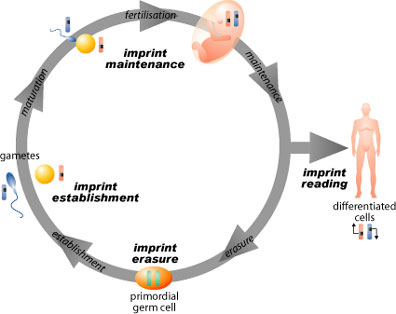
image credit:
www.bioteach.ubc.ca
Imprinted genes are localized in certain clusters in the genome where the whole cluster is silenced by methylation through certain methylases that act mainly by addition of methyl group to cytosine of spesific CpG dinucleotides within the clusters, so reducing the expression of the rest of genes in the clusters. However, Genetic imprinting is liable to modification along generations, for example if a male recieved imprinted genes from his mother, if it happens that this male will have a daughter, these imprinted genes he recieved from his mother will be activated by another process known as acetylation, where acetylated genes are actively tarnscribed. Thus, whether genes are imprinted or not depends only whether they came from a mother or father & is not a trait being passed through generations ( i.e. Non Mendelian pattern of inheritance). Diseases and developmental disorders are associated mainly when ceratin genes fail to be imprinted. Cancers have deen correlated with failure to imprint growth factors.
Tags: acetylation, Genetic, Imprinting, methylation, non mendelian
2 Comments »
Mitochondria contain their own DNA which is about 17,000 bp. Mutation in mtDNA can lead to a series of disorders known as mitochondrial disorders which will be very vivid in organs requiring high energy supply as brain, heart, eye & skeletal muscles. Owing to its oxidative function, mitochondria are having a high rate of mutations estimated to be 10 times that of nuclear DNA . However, mitochondrial disorders result also from mutations in nuclear DNA in the regions coding for mitochondrial components . For individuals having mitochondrial disorders resulting from mtDNA mutations , they have a mixture of mutated mtDNA & normal mtDNA which is a pattern of distribution known as mitochondrial DNA heteroplasmy. The proportion as well as the distribution of defective mtDNA influence the location , onset as well as severity of diseases.

image credit: www.mrc-dunn.cam.ac.uk
Conventional treatment of mitochondrial disorders is mainly supportive where patients are treated with co-enzyme Q10, which is a cofactor required for electron transfer from complexes I & II to complex III. However Gene Therapy & Modern Targetting Systems stepped in offering a radical & permenant cure for mitochondrial disorders. One of most promising strategies of Gene Therapy is allotropic expression which involves the engineering of normal genes then their introduction to nucleus. This method showed success in a mitochondrial disorder characterized by respiratory deficient phenotypes caused by a mutant MATP8 gene , where the engineered ATP gene has succeeded in production of ATPase 8 protein.
Modern targetting systems have developed offering a unique solution to mitochondrial disorders & overcoming the dilemma of heteroplasmy as well. Cell membarne Crossing Oligopolymers (CMCO’s) are molecules that are capable of penetrating cell membrane & selectively bind to mutated mtDNA inhibiting its replication. This technique has been successful in handling Oxidative Phosphorylation deficiency (OXPHOS deficiency).
Tags: allotropic expression, CMCO's, heteroplasmy, mitochondria, mtDNA
No Comments »
 For many decades, conventional vaccinology has faced many obstacles. One major problem is that among several antigens of the microbe, you have to identify the most immunogenic (and thus protective) antigens (such as virulent factors, toxins, surface-associated proteins, etc.) suitable for vaccine development. This process is very fastidious and costs a lot as it relies mainly on traditional biochemical and microbiological methods. As a summary, it is carried out as following: For many decades, conventional vaccinology has faced many obstacles. One major problem is that among several antigens of the microbe, you have to identify the most immunogenic (and thus protective) antigens (such as virulent factors, toxins, surface-associated proteins, etc.) suitable for vaccine development. This process is very fastidious and costs a lot as it relies mainly on traditional biochemical and microbiological methods. As a summary, it is carried out as following:
- Firstly, you have to cultivate the microbe and harvest proteins.
- Then you have to identify the antigens one by one.
- After that you can pass to vaccine development stage.
Introducing genomics has greatly contributed to providing a new impulse to vaccinology field. The major role it plays is in the antigen discovery stage. As the genome sequence of many microbes has been identified, the integration between the sequence, proteomics and microarray has introduced what is called “reverse vaccinology” . Reverse vaccinology (RV) means to identify and characterise the antigen using bioinformatics. In RV, you start from the genome and not from the pathogen itself i.e. you start from the opposite direction, that’s why it is called “reverse”.
RV will provide solutions to some problems that usually come up during vaccine development as:
- It will provide fast access to almost all antigens including:less common antigens and antigens not expressed in vitro.
- It represents a new approach for non culturable microorganisms.
On the other hand, the major disadvantage of RV is that it cannot be applied to non-proteinaceous antigens such as lipopolysaccharides and glycolipids.
Tags: GBS, genomics, reverse vaccinology, vaccinology
4 Comments »
 Posted by: Nehal in basics
“Mutations are the cause of almost every disease”. That is what a researcher told me when I asked her why we are very interested in studying mutations of the human DNA. Is that possible? Will the future medicine mainly depend on molecular genetics? Will each of us have his very specific genetic fingerprint included in his profile at his doctor? All those questions suddenly hit my thoughts when she continued to explain the huge impact of this new science on medicine.
You may say that if it’s mutation, we can simply “fix” it through gene therapy but still gene therapy is not approved by FDA and there are high risks and also considerable percentage of failure in this type of therapy. Well, I can tell you that this is not the only reason driving us to study gene mutations or mutations in general.
There were two old misconceptions (and may be still present). The first was that all diseases are only caused by environmental factors while the second was that congenital genetic diseases must be shown on parents. Studying mutations on DNA level proved that those are not necessarily true. Many widespread well-known diseases such as hypertension and also diabetes were recently known that they are of genetic origin. On the other hand, some cases of congenital mental retardation causes such as phenylketonuria (PKU) found in the newborn and not clearly shown in both parents.
There are also many good reasons why the interest in studying mutations raised lately. I can tell that one of them was the Human Genome Project. Since we can know most of the genes and we can easily get the sequence of any DNA sample, why don’t we study the “changes”? I think that’s the base of every science. We figure out the “normal” and then look up for the “abnormal”. Or, how can we be so sure about the “normal” unless we study the “abnormal”? That makes real sense to me.
She kept opening boxes, some I know and some I really didn’t know about. She also said that DNA analysis and sequencing is very important before marriage. Susceptibility of the expected child to some diseases (on the genetic level) may be also verified. Although it seems more of genetics but it’s true. Some mutations are inherited just following the Mendelian law. She gave me example; say that expected mother has mutation “deletion” in one of the genes while the expected father has mutation “insertion” in the same gene, the expected child may not be affected. On the other side, if both have deletion or insertion, there will be another pathway for this marriage.
On the prenatal level, we can actually save lives and avoid many complicated consequences that may happen. A sample from amniotic fluid or the pregnant mother blood (better to be the amniotic fluid), we can study how our fetus’s DNA is. If it is impossible to survive or it shall have tragedy in its life, legal abortion is carried out. If it is a milder case and the baby can survive for long period, we can maximize its opportunity as in the case of previously mentioned PKU. We know that certain types of food elements will enhance mental retardation; we can totally avoid them and guarantee a healthier happier life for both child and parents.
She emphasized on one thing I didn’t, previously, take care of; the diagnosis. She explained by saying that in many cases, especially cancer, we need to take a biopsy to send it to the pathology lab to say whether it’s benign or malignant. In prostate cancer for example, it’s more close to a surgery and we may be led to prostatectomy which is very painful whether physically or psychologically. Mutation analysis may save all that and provide us with non invasive method for diagnosis. ( I have to clarify that in some diseases, biopsy is better and more specific than blood sample for example, congenital heart diseases)
We all know that many diseases are multi-factorial which means that one thing happened leads to this and this leads to that and the same that causes another that..etc. So, it might be difficult tracking down the “single main factor” which was the first troublemaker. DNA can tell us about it. By detection of mutations, it may clarify what is the real reason of this dilemma. She opened a totally new box to me; unresponsiveness to the drug; the usual therapy not gene or any correction. I had a very small background about pharmacogenomics that sometimes we need to “tailor” the dose for every patient due to the fact that we are not simply the same. But, she gave me an additional interpretation to that shocking fact. Nephrotic syndrome is a disease caused by abnormality in the kidney mainly the glomeruli in the nephron; the functional unit of the kidney. It leads to many endless complications such as oedema and hypertension. One of the ways to treat it is steroids. Although it is a magical drug but it stabs us in the back. We can take the risk and treat the patient with steroids but it gives no effect. That’s due to mutation variation between different patients.
Going back to cancer, if one of the family members previously had cancer, it might be, with considerable percentage that it’ll be inherited to another family member. This also ensures the importance of studying our genes and how they “change”.
Not all mutations are that terrible. “If it weren’t for some mutations, we wouldn’t have survived”. One of my very respectful doctors told us that. I simply wouldn’t be writing you this post and you wouldn’t be reading it. There is no absolute. Everything has its good and bad side. The clever is who use the good and take care of the bad.
1 Comment »
 Two years ago, the project of sequencing the Neanderthal genome started. They (Max Planck Institute & 454 Life sequencing) promised to end by this year. Well, they kept their promise. Frankly, some mitochondrial DNA sequences (mtDNA) have been published but contamination was the major defect in those published sequences. They collected more than 60 bone specimens from museums (We’re talking about 38,000-year-old bone); they repeated the sequencing for 35 times in the same clean room of extraction to avoid contamination with human DNA. Two years ago, the project of sequencing the Neanderthal genome started. They (Max Planck Institute & 454 Life sequencing) promised to end by this year. Well, they kept their promise. Frankly, some mitochondrial DNA sequences (mtDNA) have been published but contamination was the major defect in those published sequences. They collected more than 60 bone specimens from museums (We’re talking about 38,000-year-old bone); they repeated the sequencing for 35 times in the same clean room of extraction to avoid contamination with human DNA.
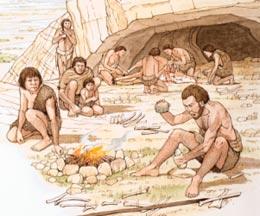
From the total 13 protein-encoding genes of the sequenced mtDNA, they identified only one with amino acids difference than the human sapien version. It is cytochrome c oxidase subunit 2 (COX2 – part of the respiratory chain), but even this difference has no significant effect on the functional domain of COX2. They hope to answer this questions in a few months: Why Neanderthals died out & human didn’t?!
We already know that Neanderthals & humans share 99.5% of the sequence, but answering questions about having a common ancestor & extinction through absorption (bred with humans) needs lots & lots of researches, collecting & sequencing samples at different time intervals to come with hypotheses. The mtDNA is not enough as Trinkaus (an expert on Neanderthal biology and human evolution) said: “The genome sequence data may tell us something about the selection of a couple of proteins, but it tells us nothing about language or social behavior.”
Image credits:
Reconstruction of a Neanderthal child from Gibraltar: http://en.wikipedia.org/
First complete Neanderthal genome sequenced: http://www.nature.com/
Tags: 454 pyrosequencing, genomics, human genome, human genome project, max planck institute, mtDNA, neanderthal
2 Comments »
|


 Entries (RSS)