Archive for February, 2009

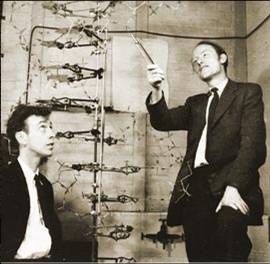
Watson - Crick DNA modelOn February 28, 1953, James Watson and Francis Crick announced to their friends that they have discovered the chemical structure of the DNA. After publishing their paper in Nature on April 2, the official announcement took place on April 25.

That is what I have read in Al-Ahram newspaper today. What a discovery! Imagine if they had not done it, we would have had no clue about genes & protein synthesis, no recombinant DNA tech- & no sequencing. We would have had no molecular biology departments in universities! Abby from NCIS & Greg from CSI would have had no job!

So, what was the real story? To what extent are the “rumors” saying that Rosalind Franklin is the real discoverer of the DNA double helix right? Is she really the “Dark Lady of DNA”?Rosalind Franklin

I hope we can get the story through your comments after we read this:

1- Crick papers from the National Library of Medicine.

2- Watson’s interview with a group of top North Carolina high school students in 2003.

3- BBC celebrating the 50th anniversary of DNA structure discovery in 2003. (really interesting)

4- Rosalind Franklin: Dark Lady of DNA by NPR (National Public Radio)

Image credits:
Watson – Crick DNA model: http://www.cs.princeton.edu/
Rosalind Franklin: http://www.npr.org/

Tags: , , , ,

Comments No Comments »

Streptococcus pneumoniae is a pathogen normally found in nasopharynx of about 5-10 % of healthy people. Despite its name, it can cause many other diseases as meningitis, septic meningitis, otitis media,osteomyelitis.

S. pneumoniae main virulence factors are:

a) Polysaccharide capsule: that inhibits phagocytosis.

b) Pneumolysin: a protein that causes lysis of host cells & activate complement.

c) Hydrogen peroxide: causes damage to host cells.

d) Pili: contribute in colonization of upper respiratory tract and increase the formation of large amounts of TNF.

Researchers led by Jesús M. Sanz at the Miguel Hernandez University and Maarten Merkx at the Eindhoven University of Technology have now introduced a highly promising new approach for the development of drugs to treat pneumococci.

The cell wall of pneumococci contains special polymers, called teichoic acids that are rich in choline which act as a docking station for a number of special proteins that are involved in important processes as:
1) Cell wall division.
2) Release of bacterial toxins.
3) Adhesion to infected tissues.

If choline is added to a culture of pneumococci, the molecules occupy the choline binding sites of the CBPs so that the proteins can no longer bind to the cell walls of the pneumococci.

The bacteria continue to multiply but they can’t separate from each other, these results in long chains of linked cells. Also, the toxin released is stopped.

However, choline is not suitable to be used as a drug because an effective dose would be far too high.

The researchers thus developed the foundation for a new drug that binds CBP much more strongly than individual choline molecules. The drug imitates the choline architecture of the cell wall by presenting multiple choline groups. This will occupy multiple choline binding sites of the CBP.

Also, the required dosage of this CBP inhibitor lies within the range that is acceptable for pharmaceuticals.

Source: Science Daily.

Image credits: S.pneumoniae.

Image credits: S.pneumoniae.

Tags: , , , , , , , , ,

Comments 1 Comment »


StatCounter