Archive for September, 2008
Who could possibly believe that our anaerobic spore-forming Clostridia will be used as an anti-tumor therapy?! It’s called Clostridium-based tumor targeted therapy. “Give me a break,” that’s exactly what I said when I read the review of the new book Clostridia: Molecular Biology in the Post-genomic Era.
So, how does it work? There are various non-pathogenic Clostridia strains which could replicate within solid tumors upon systemic administration. The interesting part is coming right up: Why solid tumors?! It’s because of its very unique physiology; it characterized by hypoxia & necrosis which totally fits the anaerobic Clostridia. The advantage will be the selectivity & targeting of the cancer cells leading to destroying them.
It was news to me to know that Cl. perfringens causes food poisoning like any food-borne illness & causes antibiotic-associated diarrhea (When I hear the name Cl. perfringens, I orient myself toward gas gangrene right away). Its enterotoxin gene (cpe) is present on the chromosome itself (in food poisoning isolates) and on the plasmid (in the antibiotic-associated diarrhea isolates). The enterotoxin binds to claudin receptors, then there’s oligomerization or “prepore” formation & finally prepore insertion takes place to form the functional pore which kills the cells by apoptosis. So CPE/CPE derivatives could be used for cancer therapy.
Tags: anti-tumor, clostridia, Clostridium-based tumor targeted therapy, CPE/CPE, enterotoxin, solid tumors
 2 Comments »
Did you ever think about only one disease that causes the death of 50 million people? and around a year!!!!
Unfortunately, it already happened between 1918-1919 and is known as Spanish flu.
Flu (influenza) is a highly contagious respiratory infection caused by influenza viruses, which are divided into three types A, B and C.
Type A influenza is the most frightening and epidemic.
Type B influenza causes milder symptoms than type A.
Type C influenza tends to be mild and does not spark epidemics.
Type A flu virus is subdivided into subtypes based on two surface proteins, hemagglutinin (HA) and neuraminidase (NA).
Now, Scientists know 16 HA subtypes and 9 NA subtypes of the flu virus.
A (H1N1) and A (H3N2) are the subtypes of influenza A viruses found in people, and there are no subtypes of influenza B virus.

The influenza viruses contain eight segments of single-strand RNA , continually change over time through “antigenic drift” or “antigenic shift”.
So, there is new flu vaccine every year and from time to time we face a new flu outbreaks.
Now, there is real fear between scientists and people of transmission of influenza viruses from animals to people.
There is a promising trial of new flu vaccine , targeting the internal proteins of the virus, this vaccine may be used in vaccination of many viruses like flu in mechanism of infection. (you can see BBC report Here).
References :
Flu
What Is Flu?
Types of flu
Influenza virus
History of Flu Epidemics
The Influenza (Flu) Viruses
Types of Influenza Viruses
Flu Virus Can Change: “Drift” and “Shift”
For Further reading
Seasonal Flu
Flu Channel
Cold Channel
Bacterial Pneumonia and 1918 flu
Tags: 1918 flu, antigenic drift, antigenic shift, flu, flu outbreaks, hemagglutinin, influenza, neuraminidase, spanish flu, ssRNA, types of flu, vaccine
No Comments »
 Researchers at Yale & the University of Chicago were faced with a surprising conclusion based on their scientific experimentation on mice. Unlike the common belief that microbes are in fact “bad” & possess a harmful threat to our health, some of these bacteria prove their innocence. Mice, that were exposed to common bacteria in the normal gut flora, were protected against the development of Type I diabetes. Previous research had shown that mice, exposed to killed Mycobacterium tuberculosis, were also protected. So, this means that mice that grow in their natural habitat are better off than the ones raised in the much improved sanitary conditions of the lab. Researchers at Yale & the University of Chicago were faced with a surprising conclusion based on their scientific experimentation on mice. Unlike the common belief that microbes are in fact “bad” & possess a harmful threat to our health, some of these bacteria prove their innocence. Mice, that were exposed to common bacteria in the normal gut flora, were protected against the development of Type I diabetes. Previous research had shown that mice, exposed to killed Mycobacterium tuberculosis, were also protected. So, this means that mice that grow in their natural habitat are better off than the ones raised in the much improved sanitary conditions of the lab.
This comes to support the hypothesis many scientists have lately adopted. They tend to believe in a directly proportional realtionship between a person’s exposure to parasites, bacteria, worms, etc.. within the surrounding evironment and his immunity. The more, the better..that is within limits of course.
This actually makes perfect sense to me. It is really obvious when you see, for example, people living in third world countries with mosquitoes hovering around and considered normal. But when they travel abroad for a while and come back, they get different sorts of allergies & rashes from those previously “harmless” mosquitoes. What parasites and microbes do for you is not all bad. Unfortunately, I had to experience this dilemma.
Source: ScienceDaily
Tags: bacteria, diabetes, flora, immunity, mice, tuberculosis, Yale
No Comments »
Sept 16th:
Hi, Diary;
Now it’s in the press. It’s humiliating. In Scientific American, it was written under the title: Turning Bacteria into Plastic Factories. So that’s what we, E. coli, turned into: slaves for humans to do whatever they want us to do.
I remember this like it happened yesterday. It was someday in the beginning of the year 2008. That day we found ourselves in those tanks, large ones, filled with sugar & water. “This is great; we can ferment the whole amount of sugar in the tank. This is the perfect place to live in,” that is what we thought. Then we got this strange order from our genomes or plasmids, I’m not sure & found ourselves producing that enormous amount of 1, 4- Butanediol (BDO). This was so strange because BDO used to be toxic to us at low levels (I’ve heard once that any production of a non-native material inhibits our growth). Then we realized the truth; we’ve been genetically engineered to tolerate BDO, the raw material for a very large number of plastic, rubber and fiber products including solvents, fine chemicals, pharmaceuticals, automotive components, electrical and electronics components, as well as apparel fibers.
Honestly, I don’t know. Sometimes I feel that bioengineers from San Diego-based Genomatica, Inc. are right after all; they modified us, they wanted to make use of us, they wanted to save money & energy needed to produce BDO from non-renewable petrochemical feedstocks, the currently used method. Plus it causes us no harm as Bioengineer Christophe Schilling, president and co-founder of the company said: “We have engineered the organism such that it has to secrete that product in order for it to grow.”
Now I know what it feels like with my fellow bacterial species, the natural born producers. Most bacteria synthesize the organic polyesters Polyhydroxyalkanoates (PHAs) to be used as a carbon & energy storage material. Now they’re discussing the ability to use these PHAs as biodegradable plastics.
 Source: A piece of a plastic notebook found in the Petri dish appears in the picture below, Genomatica labs, San Diego. Source: A piece of a plastic notebook found in the Petri dish appears in the picture below, Genomatica labs, San Diego.
Image credits:
Genetically engineered E. coli may produce plastics: http://www.sciam.com/
Tags: BDO, biodegradable plastics, Christophe Schilling, genetically engineered, Genomatica, PHAs
3 Comments »
 Have you ever heard about the terrorist attacks of anthrax via mail in 2001 in US that finally ended with Bruce Ivins, the chief suspect in those attacks, committing suicide? Have you ever heard about the terrorist attacks of anthrax via mail in 2001 in US that finally ended with Bruce Ivins, the chief suspect in those attacks, committing suicide?
What about tracing microbe sources as in the Salmonella US outbreak?
This is microbial forensics.
Microbial forensics uses biological analysis such as genome sequencing, protein and carbohydrate fingerprinting to figure out the source of a biological agent. 2001 was not the year which witnessed the emergence of microbial forensics. Actually, in 1998 a doctor from Louisiana, who intentionally infected his former mistress with HIV, had a trial in court. But the anthrax attacks were really the reason for the amplification of the role of microbial forensics as it was followed by government funding and developing the sequencing techniques into more cheaper ones.
As a result, microbial forensics is extrapolated to further applications beyond biocrimes. In molecular epidemiology, it will help figuring out the source of food or water borne diseases such as in recent US Salmonella outbreak. The field also is expected to provide help in hospital-acquired infections. Many people sue hospitals every year claiming they got MRSA (methicillin-resistent Staphylococcus aureus) infection from a certain hospital. Tracing the source of the infection will prove whether those people really contracted the infection from the hospital or from any other outside source.
Image source
Reference: Ontogeny
Tags: bioterrorism, Epidemiology, forensics, MRSA, nosocomial infections, Salmonella
5 Comments »
 Recently, I have been able to get in touch with Professor Jan Roelof van der Meer after reading about his work in EurekAlert in the field of color-coded bacteria. Currently, he is an associate professor at the Department of Fundamental Microbiology, University of Lausanne. Recently, I have been able to get in touch with Professor Jan Roelof van der Meer after reading about his work in EurekAlert in the field of color-coded bacteria. Currently, he is an associate professor at the Department of Fundamental Microbiology, University of Lausanne.
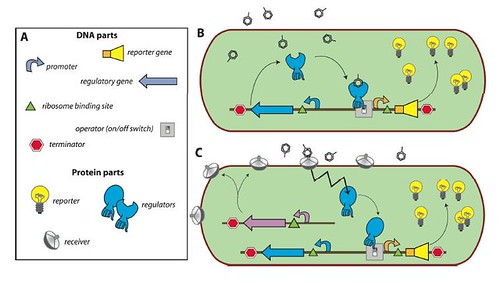
In a review published in collaboration with Professor Robin Tecon, the researchers explained why the bacteria were specifically useful in the detection & tracing back the age of oil spills, chemicals and other pollutants leaking into seawater and the soil. Since the bacteria are easily manipulated, researchers were able to genetically produce MBS “Microbe-Based Sensors” which produce specific reporter proteins when in contact with a certain pollutant. Such reporter proteins can then be detected merely by observation or instrumentally.
Enclosed within the review, this figure illustrates the concept of a bacterial sensor-reporter cell where the benzene-ring-look-a-likes represent the pollutants.
And I leave you with the interview:
1. Is there hope that MBS won’t just play a role in detection, but in cleaning up as well?
Normally not. To enhance biodegradation rates in the environment, one usually tries to stimulate the bacteria which are already present at the site. There are no cases where genetically modified bacteria were applied to clean up contamination.
2. How can this method trace back the age of a spill?
Interestingly, we found that there seems to be a specific pattern of dissolution of different compounds from oil. A fresh spill will first ‘show’ linear alkanes and compounds like benzene, toluene, ethylbenzene. Only later will polycyclic aromatic hydrocarbons, like naphthalene, appear. We had not seen this before, because one typically cannot measure the first phase of an oil spill, since this is detected only after a while.
3. Which method do you prefer in the genetic engineering of these MBS?
Depends. For E. coli, we use very classical cloning techniques involving plasmids. For other bacteria, we have to use transposon delivery methods mostly.
4. Is the acquired trait of producing a reporter protein passed on to future generations of the bacteria?
Normally yes. If the reporter construct is integrated in the genome of the bacteria, it is relatively stably maintained even without selection pressure for the marker. When the construct is on a plasmid, like in E. coli, one has to constantly keep the ‘pressure’ for the marker on the plasmid, usually an antibiotic resistance marker.
5. This field, as you kindly mentioned, started 20 years ago; what hope lies for its progess in the future?
My major hope is that people (industries, labs) finally apply the methods in their analysis as alternatives for costly chemical analysis. Further progress has to come from miniaturization, multiple target detections and improved methods to preserve the bacterial cells.
Tags: bacteria, biosensor, color coding, genetic engineering, Lausanne, MBS, oil spill, reporter protein, van der Meer
2 Comments »
“Did you brush your teeth today ??”
I think you will ask this question to yourself & your family daily.
When you know that bad oral hygiene will drive you to heart disease, many of us may change his opinion.
Simply, people who don’t brush their teeth regularly will start with inflammation of their gums “Gingivitis“.
If this situation continues, a chronic inflammation occurs “Periodontal Disease“ with a bleeding gum.
Bleeding gum is a great risk factor, as it provides an entry to the blood stream for 700 different types of bacteria.
Streptococcus gordonii and Streptococcus sanguinis are two common infecting agents.
After they reach the blood stream, they bind with blood platelets, this creates two problems:
First: If we use an oral antibiotic to kill oral bacteria thus preventing them from reaching the blood stream, by time bacteria become resistant.
Second: The binding of bacteria with platelets encases them & shields bacteria from our immune system till they reach the heart causing heart diseases.
So, if we prevent the binding between bacteria & platelets, this will help our immune syst em kill bacteria & protect our heart. em kill bacteria & protect our heart.
“We are currently in the process of identifying the exact site at which the bacteria stick to the platelets” said Professor Howard Jenkinson. “Once this is identified we will design a new drug to prevent this interaction.”
Source: Bristol University news.
Image credits: Periodontal Disease
Image credits: Professor Howard Jenkinson
Tags: bleeding gum, Gingivitis, Heart Attack, Periodontal Disease, Streptococcus gordonii, Streptococcus sanguinis
3 Comments »
 In a study conducted by researchers in the University of Maryland School of Medicine, physical activity has proved to counteract FTO gene “fat, mass, and obesity-associated gene” in a group of European descendants who resided in the USA, known as Old Order Amish. In a study conducted by researchers in the University of Maryland School of Medicine, physical activity has proved to counteract FTO gene “fat, mass, and obesity-associated gene” in a group of European descendants who resided in the USA, known as Old Order Amish.
FTO gene has recently been linked to obesity & increased BMI “Body Mass Index” in numerous studies. Europeans usually have one or two copies of a variation of this gene. The research has enforced this prior assumption but brought, yet, another advantage since the study was done on 704 men & women of similar descent and thus similar genetic makeup, which what makes them ideal for genetic research. This helped researchers study the effect of physical activity on the expression of this gene.
In subjects, who were physically active throughout their daily routine, having multiple copies of the FTO gene didn’t seem to affect their BMI, despite the fact that in those, who were less active, a link between their BMI and FTO gene was obvious. This suggests that the choices one has to make in everyday life can deeply impact our body’s response to its own genes.
In order to compare the different variations in this gene, subjects were asked to wear accelerometers to measure their body movement on a 24-hour basis for seven days. They were then classified accordingly in order to conduct a comparative analysis. The genetic analysis revealed that 26 SNPs in the FTO gene were linked to BMI.
In the future, this may help tailor methods to prevent obesity in genetically susceptible individuals. So, after all we can’t blame it on our genes. Our decisions might in fact make up who we are & who we will become.
Source: Medical News today
Original research paper: Physical Activity and the Association of Common FTO Gene Variants With Body Mass Index and Obesity. PMID: 18779467 (Vote for the abstract on Biowizard)
Image Source
Tags: accelerometer, Amish, BMI, fat, gene, gene variant, obesity, SNPs
1 Comment »
It is something like a dream, Marijuana, which is known in Egypt as “Hashish “, is used now as an antibiotic.
Marijuana is a herb planted in many countries as middle east eastern, Europe & Africa.
It is ingested by smoking, which quickly delivers active ingredients to the blood system. Marijuana has analgesic, anti-emetic, anti-inflammatory, sedative, anti-convulsive, and laxative actions.
Also, it is used in chemotherapy to relieve nausea & vomiting and for AIDS patients as stomachic.
Scientists tested five major active ingredients called cannabinoids on Different strains of MRSA “methicillin resistant Staphylococcus aureus“.
Both natural & synthetic cannabinoids show germ killing activity against MRSA.
These active ingredients exhibit antibacterial activity in a different way, meaning that they might be able to bypass bacterial resistance.
At least two cannabinoids “out of 5″ can be used safely without causing mood alteration.
MRSA like other Staphylococcus spread by contact, so people of close contact are of high danger.
Finally, researchers in the Journal of Natural Products call for the further study of antibacterial uses of marijuana as it is too difficult to find new antibacterials since unfortunately, bacteria became resistant to them.
Source : Web MD
Tags: bacteria, Cannabinoids, Hashish, Marijuana, methicillin resistant staphylococcus aureus, MRSA
4 Comments »
As we learned in pharmacology, the drug upon reaching the site of action, it gives a certain response. However, what if that response varies among individuals in terms of potency, duration or even adverse effects. As an example, in 1950s it has been noticed that Caucasians show prolonged effects to suxamethoniun chloride where further investigations revealed that 1 in every 3500 Caucasians has a less efficient butyryltranseferase, that metabolizes suxamethonium chloride, thus showing prolonged half-life & slower recovery from surgical paralysis. This fact has led to the emergence of a very unfavourable term “especially to clinicians”, Idiosyncrasy, which means the abnormal response to drugs, food & toxic agents that is peculiar to an individual. However, understanding the basic underlying mechanisms that led to this variation, made the scientists realize that in this case, the drug response is not only a matter of pharmacodynamic effects but is considered as a ring holding pharmacology at one side and the genetic make up (which is the DNA sequence of any protein dealing with the drug as receptors, carriers, metabolizing enzymes………, etc) at the other side. This understanding led the scientists to replace the old term of Idiosyncrasy with a better descriptive term known as pharmacogenetics.

image credit: www.medigenomix.de/
Variations in the genetic make up are diverse in types. The most common type is Single Nucleotide Polymorphisms (SNPs) which are single nucleotide substitutions that can be found in coding and non-coding regions in the DNA sequences of protein systems dealing with the drug. Another form of variation can be chromosomal aneuploidy as Trisomy, where an extra copy of a chromosome, carrying a gene coding for any protein system dealing with the drug, will in turn lead to response variation. As an example for that is in leukemic patients with down syndrome, since there is a third copy of chromosome 21 which bears Reduced folate Carrier gene that codes for the transmembrane Reduced Folate carrier system which is responsible for the of transport methotrexate inside the cell, thus having a third extra copy of this gene leads to the over expression of RFC & methotrexate toxicity due to high levels of intracellular methotrexate.
Now, with the fact that the genetic make up of an individual dictates the response has been laid down, the clinical application has become a consequent step. For example, regarding leukemic patients having down syndrome, as mentioned previously, they are highly predisposed to methotrexate toxicity & thus as a routine, these patients should be set on lower doses of methotrexate. This particular example is a little bit simple that is easily characterized by the well known phenotype of down syndrome patients. However, translating the basic knowledge of pharmacogenetics to useful clinical guidelines is a more complicated approach in terms of both characterizing the alteration in the genetic make up and the subsequent clinical decision regarding the choice of the drug, dose and the dosing schedule. For instance carrying out a SNP Genotyping for DNA sequencing and identification of SNPs is a difficult matter as SNPs are very scattered along the human genome, where it has been estimated that every 1,ooo base pair, one SNP is found. In addition, the functional characterization of this SNP on the protein level is a matter of complexity that requires well controlled studies (i.e. all other causes of response variation regarding the drug of interest are eliminated).

Inspite of the complexity of the investigations for clinical application, it is a productive promising approach that does have three positive impacts on the clinical application where upon the tailoring of the treatment protocol according to each patient genetic make up (individualized therapy), this will increase the efficiency of the medications, decrease side effects, adverse drug reactions, morbidities Image credit:& mortalities and thus reduce the finances of the clincal mangement of adverse drug reactions as well as toxicities that may be result from incompatibility of the drug with the genetic make up of the patient.
http://www.pharmacogeneticsinpsychiatry.com
Read the rest of this entry »
Tags: aneuploidy, Clinical application, functional characterization, Genetics, idiosyncrasy, pharmacogenetics, Reduced Folate Carrier, response variation, SNPs, suxamethonium chloride, trisomy
No Comments »
|


 Entries (RSS)